

The agentic enterprise: AI systems now operate at a scale and speed that outpaces traditional security controls. Indeed, autonomous AI agents are no longer a pilot-program curiosity. They’re operating in production environments across every industry, executing tasks, accessing sensitive data and making decisions at machine speed — often without meaningful security oversight. Enterprise leaders know this. What fewer of them are prepared to admit is how far ahead of governance the deployment curve has already run.
The gap is measurable and alarming. According to Deloitte's State of AI in the Enterprise report (January 2026), 73% of enterprise leaders cite data privacy and security as their top AI risk concern. Yet only 21% have a mature governance model for autonomous AI agents in place. Meanwhile, IBM's Cost of a Data Breach Report (2025) found that 20% of organizations have already suffered a breach directly linked to shadow AI. Among those breaches, 65% resulted in personally identifiable information being compromised. Shadow AI, which usually means employees spinning up LLM-powered workflows, is no hypothetical future risk. It’s already present, well-documented and costly. Sometimes, shadow AI also extends to include sensitive data flowing through pipelines never designed with governance in mind. Whatever the definition, AI needs to exit those shadows.
Every CISO and CTO in a large enterprise recognizes this problem in their gut, if not yet in their incident logs. The question is no longer whether agentic AI introduces risk. The question is what, specifically, to do about that risk. The key decision is whether your organization will act before or after the breach that forces that conversation to occur.

The real barrier to AI scale
The challenge facing enterprise security teams is not the pace of AI adoption itself. Organizations have proven capable of deploying AI at remarkable speed. The real barrier is their inability to govern adoption at scale, with the precision and confidence that regulated industries and security-conscious boards need.
Traditional security tools were not designed for agentic AI. They were built for a world of static applications, human users and well-defined network perimeters. None of these things describes a modern AI-enabled enterprise. Point solutions offer incomplete visibility, and policy enforcement remains inconsistent across hybrid and multi-cloud environments. Most critically, there is no reliable rollback capability when an AI agent makes an error or exceeds its intended scope.
The result is a bifurcated market: risk-averse organizations apply the brakes on AI initiatives, forfeiting competitive advantage. Bolder ones accelerate forward and operate on hope. Neither posture is acceptable. That goes double for any serious enterprise with fiduciary obligations and regulatory exposure.
A new control layer for the agentic era
Veeam Agent Commander is purpose-built to resolve this impasse. Positioned as a DataAI Security & Resilience platform, Veeam Agent Commander is not another point solution stacked onto an already overcrowded security stack. It is a unified control layer built specifically for the convergence of identity, data, security, and AI risk. Those represent the four dimensions that agentic AI collapses into a single, urgent problem space. Its architecture is organized around three core capabilities: Detect. Protect. Undo.
Detect addresses the fundamental visibility problem that makes shadow AI so dangerous. Veeam Agent Commander surfaces what other tools miss — hidden AI agents, unsanctioned deployments, and toxic data-access combinations — through the Data Command Graph. This graph maps every relationship between sensitive data, AI agents, user identities, and access patterns across the enterprise, spanning production environments and backup infrastructure simultaneously. Auto-classification of sensitive data runs continuously, and early AI risk detection delivers actionable intelligence to security analysts rather than the vague, context-free alerts that cause alert fatigue. When your team can finally see every agent, every data pathway, and every risky entitlement in a single unified view, the threat surface stops being a black box.
Protect operationalizes that visibility through comprehensive AI guardrails enforced at scale. Veeam Agent Commander can block malicious prompts and outputs before they propagate, ensuring AI agents stay within approved behavioral boundaries. It also continuously enforces compliance posture against major regulatory frameworks — including NIST AI RMF and the OWASP Top 10. That turns policy enforcement into a systematic, always‑on control layer rather than an ad hoc, manual process. For organizations facing rigorous audit and compliance demands, this shift from reactive oversight to proactive governance is both transformative and essential.
Undo is the capability that truly sets Veeam Agent Commander apart. When an AI agent makes an unwanted change — whether that’s an incorrect write, an unexpected modification, or an outright deletion — Agent Commander captures a complete, forensic timeline of its file‑level actions. Because it tracks reads, writes, modifications, and deletes, Agent Commander can precisely roll back those changes with a single click. The result is a controlled, reversible environment where organizations can let AI agents operate with confidence, knowing that any unintended file‑level impact can be quickly and accurately undone. Recovery is fast, targeted, and reliable. This is not a full-system restore that destroys hours of legitimate work alongside the error. It is surgical remediation, applied exactly where it is needed, without collateral damage or impact outside the blast radius.
Operationalizing DataAI security
The strategic implication of Veeam Agent Commander extends well beyond defensive posture. Organizations that have successfully scaled AI usually treat DataAI security not as a compliance checkbox, but as strategic accelerant. Indeed, for organizations, it’s built into the fabric of their security organization and continuously updated as the threat landscape evolves. Veeam Agent Commander is designed to enable exactly such a shift. It automates compliance mapping across major frameworks, generates audit-ready reports on demand, and keeps organizations aligned with evolving standards like NIST AI RMF without requiring manual intervention every time a framework is revised.
Operational intelligence is the other dimension that changes the math for security teams. Analysts can surface answers across the entire AI and data environment using plain-language queries, dramatically compressing the time from question to insight. The result, in Veeam's own framing, is direct: "We don't just secure AI; we unlock your ability to scale agents rapidly, safely, and with far fewer resources." For organizations facing pressure to do more with constrained security headcount, this is not a secondary benefit — it is the primary value proposition. Fewer resources, faster remediation, greater scale. That is the equation Veeam Agent Commander is designed to solve.
"The infrastructure to deploy AI exists. The infrastructure to trust it doesn't. With the DataAI Command Platform, Veeam is building the missing layer — combining resilience, security, governance, compliance and privacy, in one platform." — Anand Eswaran, CEO, Veeam Software
Why Veeam?
Veeam is the Data and AI Trust Company — a market leader in both data resilience and data security posture management, with over two decades of enterprise recovery experience underpinning every product it ships. Veeam protects more than 550,000 customers worldwide, including 82% of the Fortune 500, who rely on Veeam to keep their businesses running through ransomware events, infrastructure failures, and increasingly, AI-induced errors. Agent Commander is the natural extension of that heritage into the agentic era: bringing Veeam's deep contextual intelligence, governance automation, and precision recovery capabilities to a problem space that no prior generation of security tooling was designed to address. The convergence of identity, data, security, and AI risk demanded a new category of platform. Veeam has built it.
Learn More and Request Early Access
The window to get ahead of agentic AI risk is narrowing. Organizations that establish a governed, resilient AI security posture today will be the ones operating at full AI scale tomorrow — without the breach-driven reckonings that await those who wait. Explore the Agent Commander solution page and request early access to see how the platform can be deployed across your environment. Ready to see it in action? Watch the Agent Commander product demo and experience the Detect. Protect. Undo. framework firsthand. AI agents aren't waiting. Your security posture shouldn't either.

-
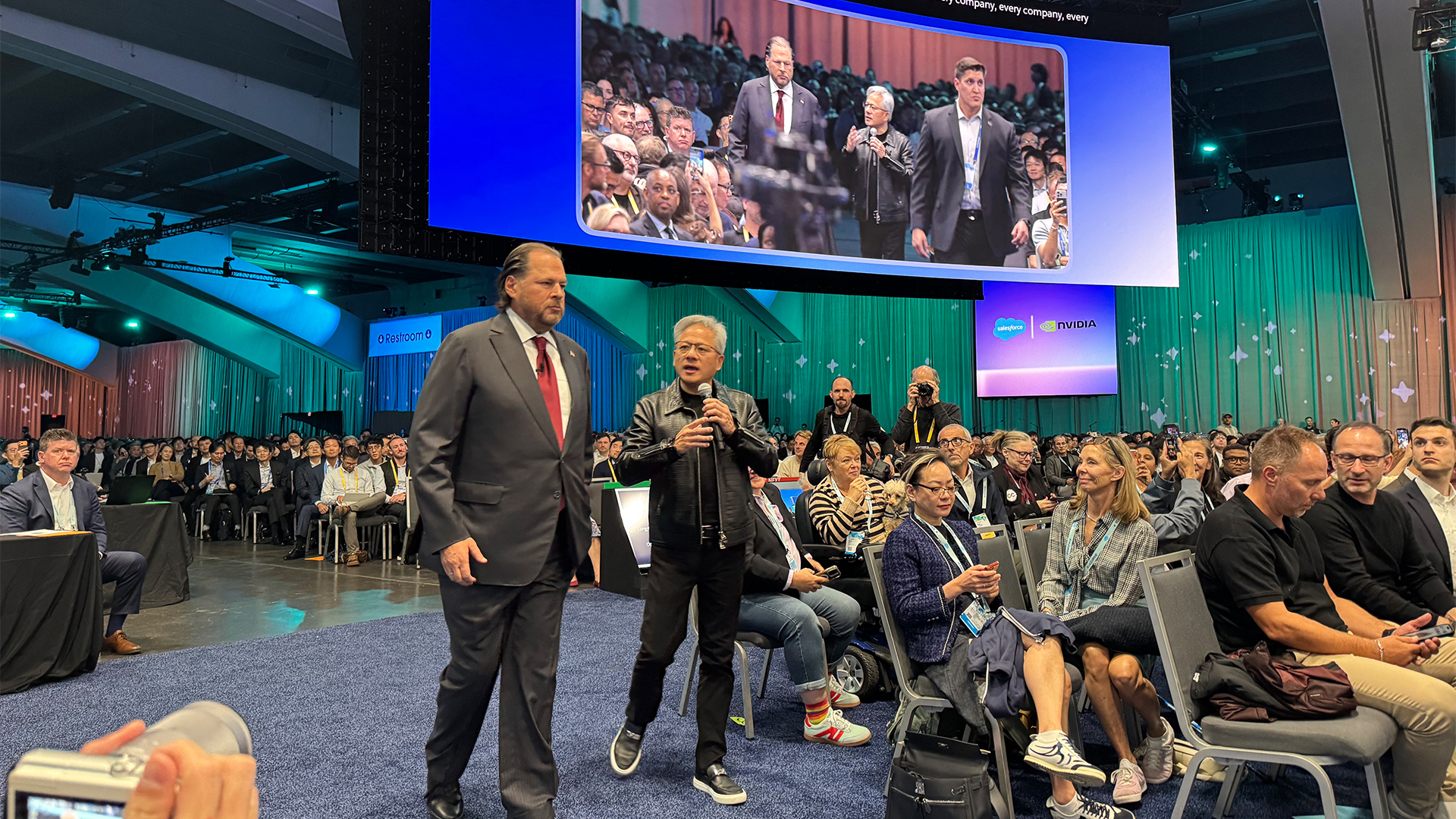 Marc Benioff and Jensen Huang aren’t sold on the ‘SaaSpocalypse’
News Reports on the death of SaaS has been greatly exaggerated, according to the Nvidia and Salesforce chiefs – but big changes are still looming for software providers
-
 Dreamforce 2026 live: All the news, updates, and announcements from day one
Keep tabs on all the news and announcements in our live coverage from Dreamforce 2026

