Dell Insprion Duo review
It's a tablet! It's a netbook! But is it any good? No, not really. Read on to find out why.
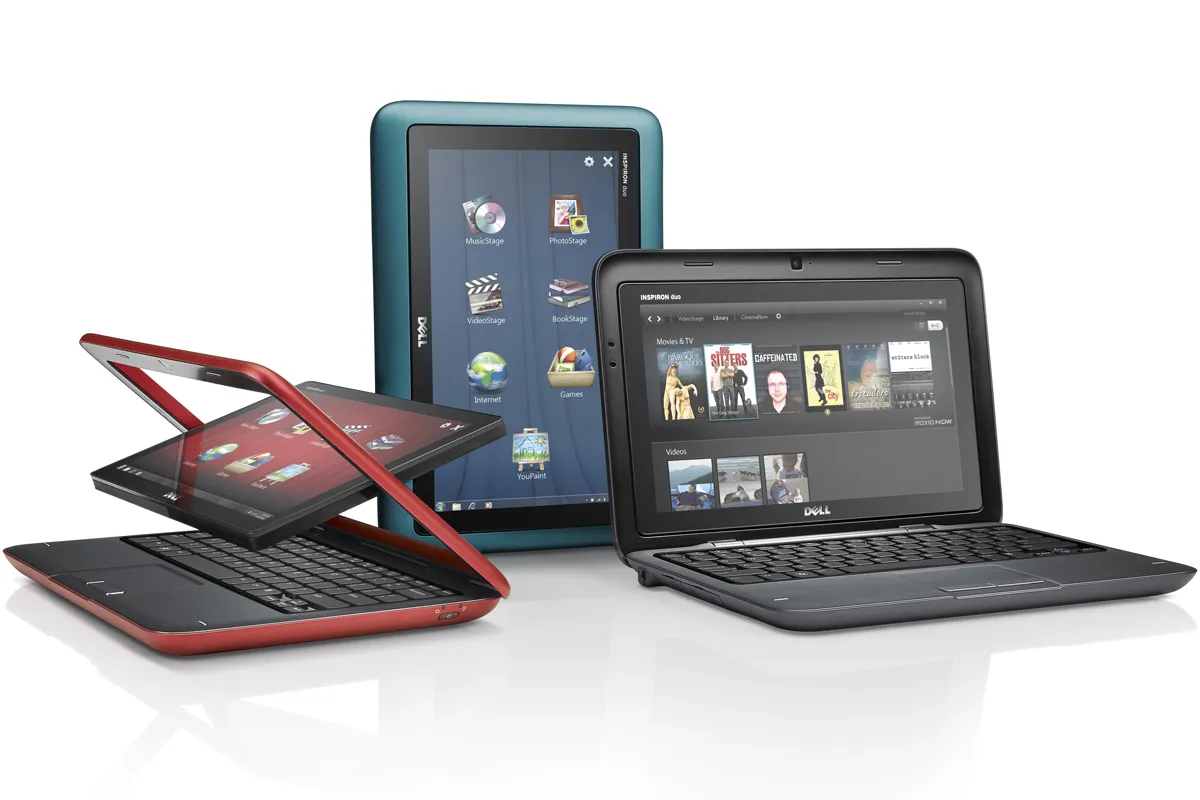
Although we were quite taken with the Inspiron Duo's spinning display, ultimately it's not very good either as a netbook or as a tablet. Although its Windows performance is good for a netbook, its poor battery life, small keyboard and missing ports limits its usefulness compared to competing models. Its touchscreen, Windows 7 and heavy weight make it a poor tablet. Unless you need an affordable touchscreen tablet for using existing Windows apps, we'd rather have any other netbook or an iPad.
The Dell Inspiron Duo is a netbook that can transform itself into a tablet. Such convertible portable computers are nothing new, but until now they have had displays that twist around and fold back to lie flat on the keyboard. The Duo uses a completely different mechanism the screen is mounted on a flip hinge inside a frame. Simply push the screen backwards with a finger to spin it backwards 190 degrees and then close the lid to turn your netbook into a tablet. The screen stays in place thanks to a series of magnets embedded in the frame. It's not only unique, but fun and eye-catching.
Although the 10in touchscreen feels reasonably responsive, since the Duo uses Windows 7 Home Premium its user interface isn't nearly as accurate or as well-designed for finger use as either iOS or Android. Although Windows 7 does support multitouch gestures, they don't feel as smooth on the Duo as they do on either more expensive Windows 7 touchscreens or the iPad. We suspect this is due to the fact that the Duo's screen has just two touchpoints, while the iPad's has around 10.
Dell has attempted to make Windows more touch-friendly by bundling DuoStage, its own touchscreen interface on top of Windows. It starts automatically when you flip the screen into tablet mode. Unfortunately, it's rather basic. Tapping the web browser icon merely launches Internet Explorer 8, while tapping the paint icon launches CyberLink's YouPaint. Dell's media browsing and e-reader apps are unsophisticated, failing to make good use of either touchscreen gestures or all the available screen space.
Even if the touchscreen and software were better, Dell's other hardware design choices limit the Duo's usefulness as a tablet. The screen's viewing angles are limited and the glossy finish reflects light very easily causing glare, so we had to constantly adjust our seating position to get a clear view.
Sign up today and you will receive a free copy of our Future Focus 2025 report - the leading guidance on AI, cybersecurity and other IT challenges as per 700+ senior executives
-
Kaseya shifts from AI ‘insights’ to autonomous action with new agentic platformNews The company aims to evolve from its suite of management tools into an autonomous operating system for MSPs
By Rene Millman Published
-
Accenture has been trialling Microsoft Copilot since 2023 – now it’s rolling out the AI tool to all 743,000 staffNews Accenture will roll out Microsoft Copilot to nearly three quarters of a million employees after years of testing
By Nicole Kobie Published
-
Compromised open source package pushed malicious Elementary CLI release to developersNews The open source Elementary CLI tool has more than one million monthly downloads
By Ross Kelly Published