

It’s well known that developing AI and large language models (LLMs) requires high-volume datasets, however that alone isn’t enough. To truly excel, the models need fast, efficient access to data, too — the kind of access that legacy storage struggles to provide. This is arguably one of the first obstacles businesses now encounter on the path to AI.
Over the last decade, the industry has gradually shifted toward high-performance storage — specialized storage designed to handle massive volumes of data with exceptional speed, efficiency, and reliability. The introduction of technologies such as solid-state drives (SSDs) and Non-volatile Memory Express (NVMe) has helped to future-proof storage infrastructure as they deliver faster access than traditional storage.
High-performance storage is designed to support rapid data access, low latency, and high throughput. This is why it’s become such a crucial asset for AI and other applications that demand extensive datasets to be processed at speed.
AI projects often succeed or fail based on the strength of their data foundation. How quickly data can be retrieved, processed, and transferred — and the speed and scale of it all — will ultimately determine success.
The growing importance of storage performance
The numbers tell a clear story. Worldwide AI infrastructure spending is projected to reach $497 billion in 2026 before surpassing $1 trillion by 2029, according to IDC. While dedicated AI storage currently accounts for a small share (2.4%) of total AI infrastructure value, enterprise demand is rapidly accelerating. Having redirected budgets toward GPUs and AI servers over the past two years, organizations can no longer defer storage refreshes. This pent-up demand, combined with the faster-than-expected scaling of inference workloads, makes a modern external storage strategy an urgent priority across the data center.
A storage system can affect multiple stages of a modern computing workflow, including how data is ingested, processed, analyzed, archived, and ultimately retrieved. That makes storage performance an architectural consideration rather than a decision that can be postponed until after compute is selected.
AI is also driving the growing demand for high-performance storage. Common wisdom may be that AI infrastructure is dependent on graphics processing units (GPUs) and specialized accelerators, but the ability to deliver data at speed is also vital.
Machine learning models, for example, are trained on enormous datasets that require continuous data accessing and transfer throughout. If the storage is too slow, it can leave expensive computing resources idle, which extends training times and increases costs.
Ultimately, better storage performance gives businesses mission-critical reliability. Whether that’s advanced caching or robust failover mechanisms, high-performance storage minimizes unexpected downtime and maintains continuous operations. This enhanced reliability and durability is the foundation for success for future projects.
The business benefits of high-performance storage
One of the biggest benefits of high-performance storage is support for highly parallel I/O, allowing multiple clients, nodes, and workloads to access data concurrently with lower latency and higher throughput. Having multiple data operations reduces latency and maximizes throughput, significantly speeding up heavy workloads. This is where SSDs and NVMe come into their own, as they’re both suited to parallel data processing. Compared with legacy disk-based systems, SSD and NVMe architectures support much higher parallelism and lower latency, helping reduce storage bottlenecks for AI workloads.
The reduced latency and higher data transfer rates high-performance storage services offer have helped to advance AI workloads across industries including finance and health care.
A large part of that comes from high-throughput systems, which can handle burgeoning data volumes and user counts seamlessly to avoid bottlenecks. As data volumes climb, storage engineered for high throughput can scale to meet demand, stay responsive, and reduce the chance of limiting an organization's success.
There’s a clear efficiency benefit, too. Processing larger workloads with fewer resources, or the same workloads in less time, improves utilization and lowers operational overhead. In practice, this means doing more work with fewer servers, which supports better cost efficiency and a stronger return on your investment.
Data protection in the age of AI
Think about your AI roadmap holistically. That’s the advice in a recent Dell blog, “Storage Is the Unsung Hero of Every Customer’s AI Strategy.”
“The compute layer may be the front-end, but storage is the delivery mechanism that feeds data to those compute resources as quickly and securely as possible,” Dell Technologies field CTO for EMEA, Stewart Hunwick, says.
“Securely” is a key point as the right storage is the foundation for future AI success. AI depends on large volumes of data moved and used repeatedly in multiple places, which creates its own security headache. That’s why resilience has to live where the data lives. Building this resilience into the data foundation from day one is what keeps enterprise Ai dependable at scale.
This is the thinking behind the Dell AI Data Platform, built to place, process, and protect data on one consistent foundation. It brings AI workloads closer to the data, cutting unnecessary movement and operational overhead and automating preparation that makes data genuinely usable for AI. It also scales unstructured performance and capacity independently, so no single AI project becomes its own infrastructure problem. The result is one consistent foundation for training and ingestion, through inference.
The foundation rests on a proven, purpose-built portfolio. PowerStore, PowerScale, PowerProtect, PowerMax, PowerFlex, and ObjectScale each address distinct workload needs while sharing a common operating experience. And Dell Technologies was also recognized as a leader in the 2026 Gartner Magic Quadrant for Enterprise Storage Platforms. Within the platform, the Storage Engines are designed to keep AI running at full speed. NVIDIA-certified Dell PowerScale, for instance, deliver the performance needed to keep GPU-intensive AI workloads moving at any scale.
The message is simple. Storage isn't a back-end utility anymore. It's the AI-ready data foundation that turns ambition into production, giving your teams the performance, scalability, and resilience to innovate with confidence, and to keep moving forward.
-
 Civo unveils first of 40 planned edge data center sites across UK
News The first site, in Hertfordshire, will open next year, with the rest coming over the next three years
-
 ServiceNow says the AI race will create a 'human renaissance' jobs boom
News AI might be transforming roles, but ‘human skills’ will still be vital for enterprises


-
 Storage is the hidden bottleneck of AI
To truly unlock the value of AI, enterprises need solid storage foundations
-
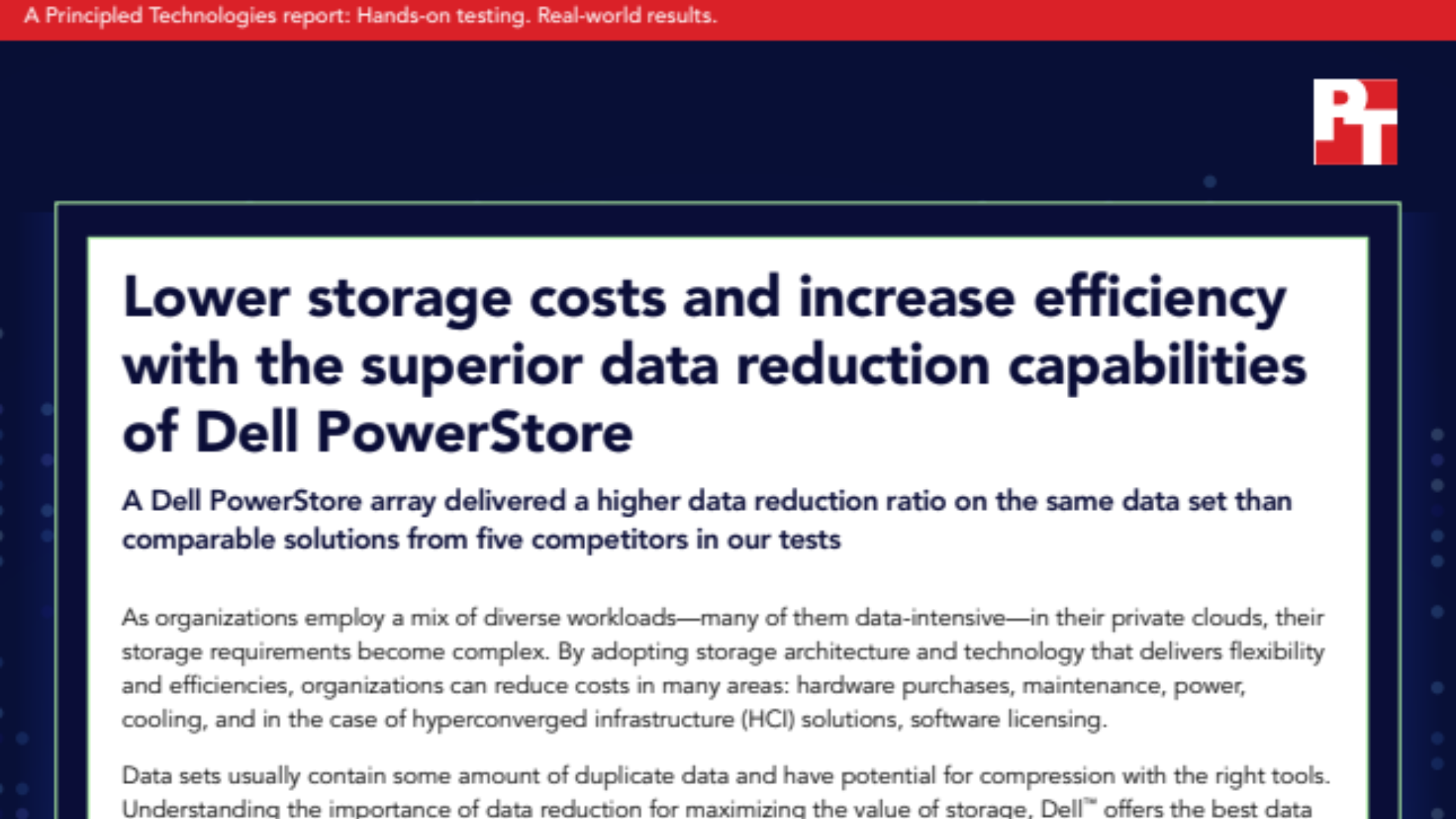 Lower Storage Costs and Increase Efficiency with the Superior Data Reduction Capabilities of Dell PowerStore
whitepaper
-
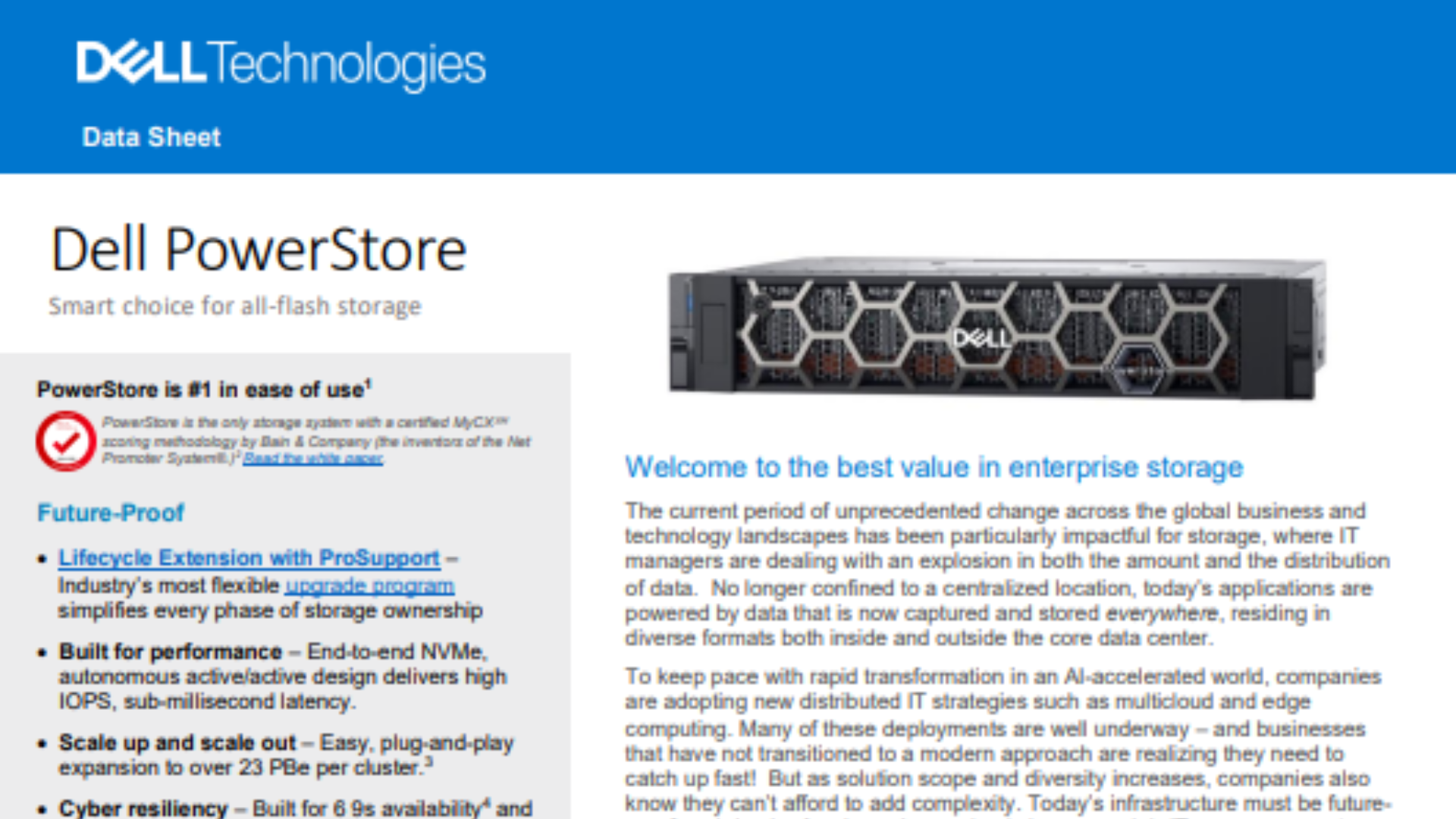 Dell PowerStore: Smart Choice for All-Flash Storage
whitepaper
-
 Maximize Performance, Efficiency, and Usability for Enterprise Storage
whitepaper
-
 Never Outgrow Your Storage
whitepaper


