
Internet Explorer 9, the latest version of Microsoft's web browser, is now one step closer to its final, finished form with the release candidate now available.
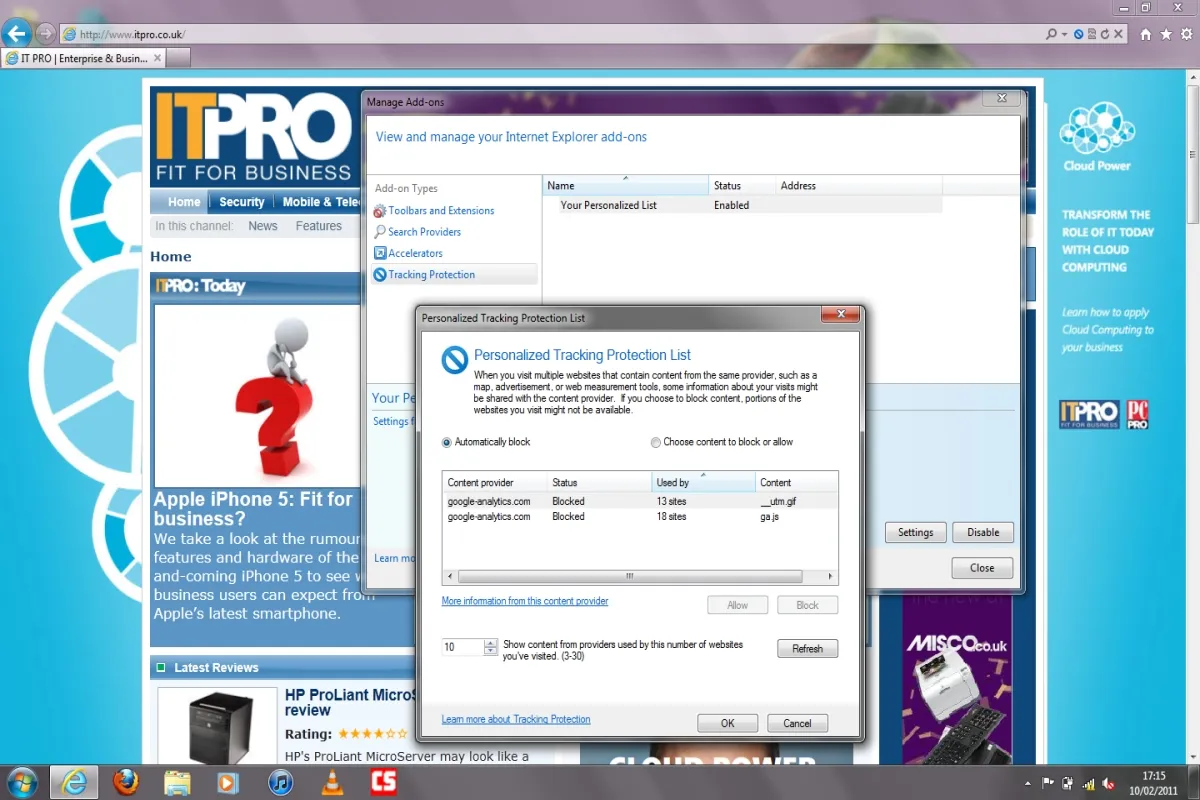
One new feature in this latest build of IE9 is Tracking Protection which should prevent advertising companies, as well as more unscrupulous characters, from tracking users and their surfing behaviour as they go from site to site.
Unfortunately, the interface isn't immediately obvious.
Users can subscribe to a list which automatically blocks trackers, or they can choose to block them on a case-by-case basis, but it's not clear exactly how this can be achieved.
There have also been tweaks to the user interface the tab bar which sits to the right of the location/search box by default can now be moved so it sits beneath the box. It's also possible to start searching for a web page immediately from the location box, instead of searching your history and bookmarks, by typing a question mark and then keywords.
The ability to pin websites to the Windows taskbar so they act more like locally installed programs has also been tweaked. For sites that support it, users can now adjust various options such as their appearance or which options appear in the site's taskbar jump list. This can be done from a settings dialogue box or a setup wizard the first time you run the site after pinning.
Microsoft claims to have boosted JavaScript performance even further and graphics hardware acceleration is now only enabled for sites that can take advantage of it. Support for additional HTML5 features, such as finding your location based on your IP address, has also been added although this geolocation feature didn't work on our wireless network.
Sign up today and you will receive a free copy of our Future Focus 2026 report - the leading resource for IT decision-maker insight on priorities and investment areas in AI, security and more.
Due to the improved security features in Vista and Windows 7 required by IE9, the new browser won't be available for Windows XP users. Microsoft's advice is for XP users to stick with IE8, which won't be discontinued.
This release candidate should be the last build before the finished version is released, but Microsoft representatives were unwilling to commit to a release date.
-
CIOs need to take back control of their IT roadmapIn-Depth IT leaders are facing difficult decisions about their ERP estates – but experts say taking an ‘AI last’ approach can avoid costly disruption
-

TfL takes Oyster photocard systems offline following breachNews Security experts warn the Oyster photocard breach could lead to follow-up attacks on victims
-

Tech giants rally to keep Mozilla's dev bible aliveNews Open Web Docs injects $500,000 into the web-development handbook used by engineers across the industry
-
Google Chrome finally axes Flash - for goodNews Chrome to start blocking 90 per cent of Flash content by default
-

Google to automatically convert Flash web ads to HTML5News Flash adverts will soon be automatically converted to HTML5, to make mobile advert experience smoother
-

YouTube now uses HTML5 by defaultNews Adobe Flash continues to get phased out
-
Adobe previews Flash alternative EdgeNews Flash may be on its last legs thanks to Adobe's new HTML5 tool, known as Edge.
-

Mozilla Firefox 4 reviewReviews The long-awaited Firefox 4 is finally here, but is Mozilla's latest browser a must-have or a has-been? Read our review to find out.
-

Google gives Chrome 10 beta a turbo boostNews The latest Chrome 10 beta boasts a 66 per cent improvement in JavaScript speed over the stable version.
-

Microsoft counters Google with H.264 Chrome add-onNews Microsoft and Google get the fisticuffs out again, this time over the H.264 video playback codec.