Asus Eee PC T-91 review
Is the search for the ultimate tablet machine over? We take a look at the finished version of the Asus Eee PC T-91.
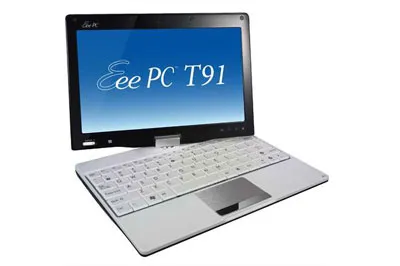
It wins an extra point just for being different but only if it cost slightly more than a regular netbook would the touch screen be enough to sway a purchase. However, the performance issues and and the reduced battery life over conventional models mean that at the price we don’t think the T-91 is worth the extra outlay.

Last week we had our first look at the Asus Eee PC T-91 - the first tablet PC meets netbook experiment. We now have a final build in front of us, complete with touch software, so it's time for the full review.
Once again, the sheer shininess of its finish attracted attention, and once again it's willing to attract fingerprints alarms.
An immediate difference we found with the shipping model is that Asus has doubled the storage capacity by including a 16GB SD card in the card reader to back up the 16GB Asus JM-S41 solid state hard disk. The card reader located on the left hand side next to a USB port is covered by a flap for protection, and there's another USB port on the right, where you'll also find a headphone, microphone, and Ethernet port.
At the back there's a VGA port and a Kensington lock so you can keep your new gadget away from opportunist thieves. As we mentioned in our first look, the keyboard is quite cramped but it is decent enough with a respectable amount of travel in the keys. There's more flex than we would have liked but it is something you'd get used to.
So what of the much vaunted touch interface? The best way of using it is to put it into tablet mode by rotating and flattening the screen, as if you tap the screen with it up, it tends to push the screen backward until it eventually topples the netbook over.
At the top of the screen you'll find an arrow which you can pull down with your finger to reveal six buttons, or 'docklets' as Asus dubs them. The one of the left is labeled 'Fun touch', which is rather worryingly named. Tap this and a list of all the touch screen applications comes up.
'Fun touch' is a photo application designed for finger use and anyone who's used an iPhone will be in their comfortable zone here. There are arrows on the side of the screen which you can press to move through a slideshow of pictures, but you can also just swipe your finger left or right. However, this is not a multi-touch capable screen so pinch and zoom motions are out instead you have to resort to the using the zoom icons on the bar at the bottom of the app.

-
 Anthropic teams up with Akamai in $11.6bn cloud partnership
News The expanded deal will help Anthropic meet “accelerating CPU workload demands”
-
 OpenAI and Anthropic could withhold new AI models from UK's AI Security Institute
News The move marks the second time Anthropic declined to submit a model for testing in the space of a month
-
 How CISA plans to shake up the CVE program
News CISA will sharpen its focus on program governance, ecosystem participation, data infrastructure, and CVE record content


