Asus Eee PC T-91 review
Is the search for the ultimate tablet machine over? We take a look at the finished version of the Asus Eee PC T-91.
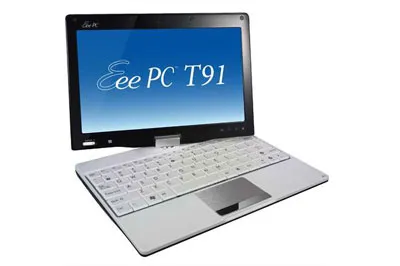
It wins an extra point just for being different but only if it cost slightly more than a regular netbook would the touch screen be enough to sway a purchase. However, the performance issues and and the reduced battery life over conventional models mean that at the price we don’t think the T-91 is worth the extra outlay.

The memo app lets you write large on virtual yellow post in notes, and once you've written your note you can send it to your desktop or email it to a friend, though this seems a little gimmicky.
The notebook pad application is perhaps the meat and potatoes app. It enables you to write on the screen in one of three ways firstly you can draw on the screen directly, secondly you can write in a box at the box at the bottom of the screen, which then converts your text, much like old school PDA's, or thirdly bring up an on screen keyboard. Trying for a while the latter was the only one I felt comfortable with, but then that does beg the question of why you're bothering with a touch screen device anyway.
That said, I could envisage it in action, say at a conference, where a user could use one to take down names like a digital clipboard as they walked around.
There's also a full screen calculator, which works well, especially in 'engineer' mode expands out to fill the whole screen and there's an internet radio, though that is only a trial application and costs $20 to use.
Magic desktop is designed to be interface for what Asus calls 'inexperienced users', but it's patently designed with children in mind. This creates a child friendly look to Windows with a fun wizard background, and fun style icons with games and fun applications and simplified mail interfaces. If you do want to let your child loose on your netbook in this mode, you can set a password, so the litte 'uns can't get to critical settings such as Control Panel.
Next to the 'Fun touch' button, you'll find one labeled 'Eee @Vibe', which appears to be nothing more than a link to an Asus web page from where you can download software - which seems rather a waste of a touch screen button to us.
Moving along, you'll find 'Eee Sharing' with links to Eee Storage', which is Asus' built-in application for backing up your content to 'the cloud'. This starts a $9.99 for 10GB, and goes up to $20 for 30GB, but some free starter storage would have been appreciated.
The Eee PC button provides nothing more than a link to sound options, while the Eee Tools tab lets you tailor the touch experience by increasing the size of the Windows XP title bar, making it easier to stab at those 'X' close buttons with your finger.

-
 Top security teams use AI agents, says Hack The Box
News Median solve times are dropping, and more teams are completing the entire challenge board
-
 Nasuni expands unstructured data platform with DryvIQ acquisition
News The vendor’s second purchase of 2026 adds content intelligence and governance capabilities to the Nasuni File Data Platform
-
 ‘We’re delivering a dynamic interface that thinks, reasons, and acts’: Three things you need to know about Claudeforce
News Anthropic and Salesforce are forging closer ties with deeper integration of Claude across core product ranges


