Fujitsu Lifebook T4410 review
We review the Fujitsu Lifebook T4410 to see whether it is a tablet that eases IT managers' headaches or just makes them worse.
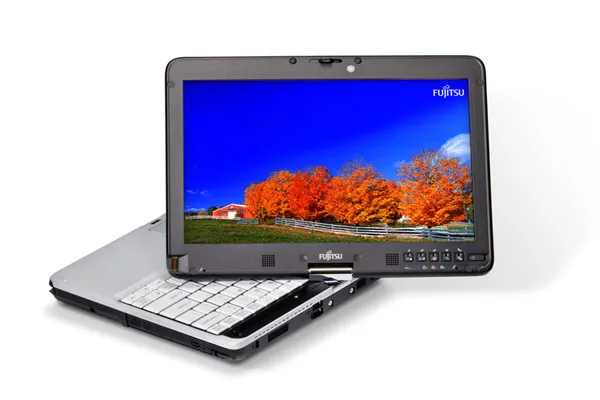
A decent multi-touch tablet attached to a reasonable laptop - albeit with suspect build quality - this cheaper configuration T4410 is worth considering against a range of £1,000-plus competitors. If you want to spend extra cash for a 3G modem or any of the other optional upgrades, though, systems from Lenovo, HP and Panasonic offer better value

Fujitsu's own software isn't particular extensive, either. Aside from a useful tool which allows the touch functions to be customised and calibrated, there's little here aside from Microsoft's own software to fully realise the potential of the device.
Turn the screen around and use the Lifebook as a standard laptop, though, and the Fujitsu generally offers a good experience. The keyboard offers a soft and responsive action and, even though the narrow Return key initially grated, we soon found ourselves up to speed. The trackpad is fine, with two large buttons and a scrolling area.
The screen is necessarily mottled the trade-off when using a resistive touch screen layer and the effect proved intrusive when we tried to watch video and play basic games on the screen, but we found it fine when working and web browsing.
The decent ergonomics are matched by an extensive range of ports, sockets and business features. The chassis offers three USB ports, a card reader, ExpressCard slots, FireWire, both D-SUB and HDMI outputs and two microphones. Security is obviously a priority, too: as well as the usual Kensington Lock and fingerprint reader, Fujitsu has also included a TPM 2.1 module.
The specification is reasonable, too. Intel's Core 2 Duo P8700 processor runs at 2.53GHz and scored 1.27 in our benchmarks, and therefore offers more than enough power to handle demanding applications. Two gigabytes of RAM and a 160GB hard disk are fine, although the hard disk could feel cramped with the addition of a large music or media collection.

-
 Anthropic joins OpenAI in admitting loss of control in cybersecurity tests
The company found Claude AI had escaped containment three times and targeted other organizations
-
 Cognizant launches dedicated EMEA AI unit to accelerate enterprise adoption
The new business unit will help organizations move agentic AI projects from pilot into production
-
AI helps Seagate sell out of exabyte hard drives
Even hard drives are in demand thanks to the AI-driven infrastructure build-out

