Ransomware that uses a fake children's charity for phishing
CryptoMix uses information lifted from children's charities to coerce victims into ransom payments

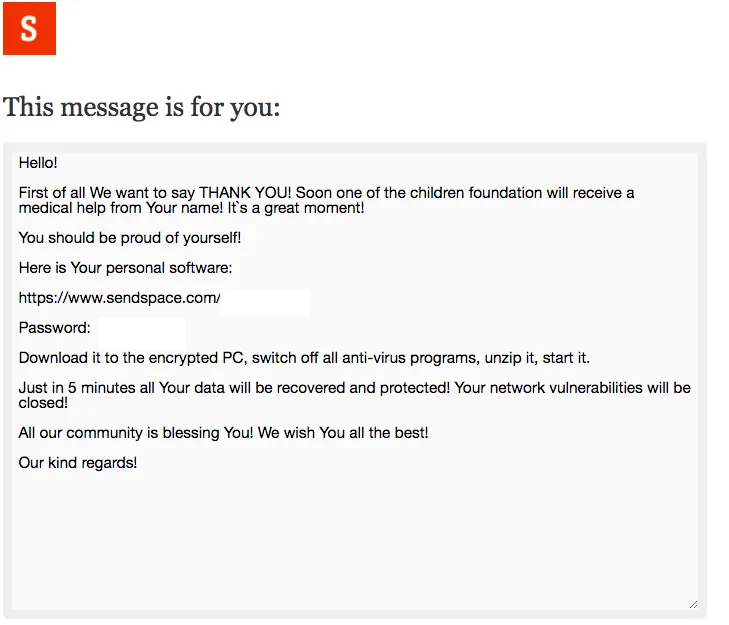
A new strain of ransomware has surfaced that pretends to be working for the good of a children's charity rather than for criminal gain, in an attempt to make handing over cash more palatable for a victim.
The newly discovered CryptoMix has been found masquerading as a Robin Hood-style of ransomware, providing links to a fictitious charity and an offer to put their name with their donation.
First spotted by cyber security firm Covewave, the ransom notes go so far as to include the names, diagnosis, and even pictures of young children that the ransom payments claim to support which, according to Covewave, the information appears to have been lifted from crowdfunding websites.
"In recent cases, Coveware observed ransom notes and communications that referenced a fictitious charity but real children," the company said. "The ransom communications begin with a .txt file that provides email addresses that the victim may use to contact the ransomware distributor."
Covewave have an example of the email exchange hackers use with this scheme. In the correspondence, they claim to work for a fictitious charity and give a description of a child's diagnosis and the funding amount being raised.

Email of a hacker using CryptoMix - courtesy of Covewave
Disturbingly, the email contained an image of what Croewave said appeared to be a 3-year-old girl lifted off a crowdfunding site.
From there, the hacker will direct the victim to view payment information with instructions on a temporary page. This page includes bitcoin wallet payment instructions and more detail on the fake charity.
"We are guessing this tactic is meant to assuage the moral hazard associated with paying a ransom," Covewave explained. "It goes without saying that these cyber criminals did think this through. It is poignantly obvious that the charity is fake, and that the details of the child's case are lifted from other sites."
After paying the ransom, a victim is given more detail about the charity as well as a message suggesting their own name will be used alongside their donation.

CryptoMix has also been identified by Avast as a particularly nasty type of ransomware that can ultimately leaves your files locked even if you pay the ransom.
This strain of ransomware was first spotted in March 2016. The spread of this ransomware could be described as a medium level of prevalence and uses exploit kits as its main delivery method.
"Once CryptoMix infects a machine, it tries to communicate with its command and control server to establish a key to encrypt files. However, if the server is not available or if there is a connection issue, such as a blocked communication by a firewall, the ransomware will encrypt files with one of its fixed keys, or 'offline key'," it said.

-
 AWS becomes first hyperscaler to secure 'NATO Restricted' approval
News The move means NATO member states and defense partners can host highly sensitive data in AWS’ cloud services
-
 How Dell PowerStore complements and supports the new world of virtualization and containers
Whitepaper As organizations shift toward cloud-native architectures, Dell PowerStore tames IT complexity by unifying legacy VMs and Kubernetes on a single, high-performance NVMe platform


-
 ‘Cyber criminal groups suffer from the same security weaknesses they routinely exploit’: ShinyHunters claims it hacked Clop ransomware rival
News An attack on the cyber crime gang could prove dangerous for previous victims of data leaks, experts have warned
-
 Companies are still paying ransoms to cyber criminals despite official advice
News A Proofpoint survey found evolving ransomware techniques and the use of AI is exacerbating the situation for victims
-
 This one cyber crime group accounted for nearly a fifth of all ransomware attacks in June
News The Gentlemen, a ransomware a service operator, now accounts for 17% of published attacks
-
 Working with the enemy: Ransomware negotiator-turned cyber criminal jailed after working with hackers to extort clients
News Angelo Martino was supposed to be negotiating on behalf of victims, but was secretly working for ransomware operators
-
 Hackers are posing as Interpol to target small businesses – here's what you need to know
News Small businesses are warned to think twice before clicking on links
-
 ‘Every hour ransomware goes undetected drastically increases its potential blast radius’: Hackers are breaching networks and laying low for longer – and nearly half of firms don’t realize until data is stolen
News An ExtraHop survey found more intrusions are going undetected, leading to longer dwell times
-
 Ransomware cartels are fragmenting into volatile splinter groups, warns Met Police cyber chief
News Commoditized "cyber crime bazaars" and AI data mining are forcing law enforcement to rewrite its playbook
-
 New ransomware threat group, The Gentlemen, has become one of the most active ransomware operators, accounting for 10% of all attacks
News NTT researchers warn that the RaaS group is leveraging SystemBC malware to establish covert tunnelling, evade detection, and support rapid lateral movement across enterprise environments


