Polycom VVX 1500 review
Video calling doesn’t necessarily mean using large dedicated suites – it can be done from a phone that sits neatly on your desk. We try out Polycom’s VVX 1500.
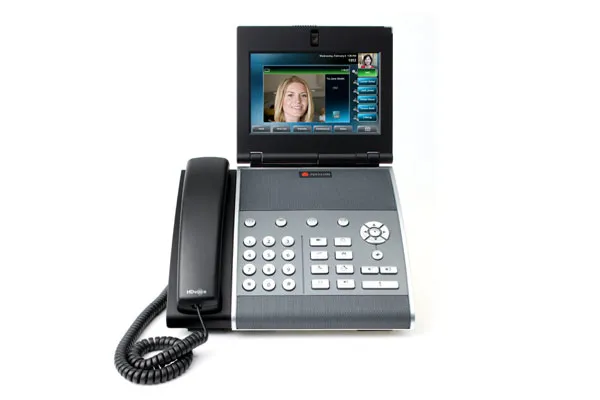
The VVX 1500 has a great range of features and is easy to configure. Full support is currently limited under most SIP server platforms, but video call routing is easily handled via a TFTP contacts directory, so this doesn't put too much of a crimp on its usefulness. Unfortunately, at over £650 (exc. VAT), it's painfully expensive compared to any IP video phone on the market short of Cisco's £1,480 7985G. If you have the budget, the VVX 1500 is a stylish and easy to use video phone that offers an elegant means of face-to-face communication between key members of your organisation. However, at this price, we have to wonder how many businesses are prepared to splash out for several of these expensive IP video phones, despite their obvious merits.

Video calling has an important place in many business environments, regardless of how you might feel about sharing your red-eyed, unshaven or otherwise less than pristine Monday morning face with the world.
Face-to-face contact can add layers of sincerity and meaning to otherwise dry or abstract conversations. The camera lets you demonstrate physical objects, read body language and, for some users, overcome hearing disabilities. Few of us are completely comfortable on video, but the camera is here to stay, whether you're a small home-grown enterprise with a Skype connection or a massive corporation scheduling regular international video conferences.
Polycom's VVX 1500 video IP phone is one of the most sophisticated we've ever seen and, at around 659 (ex VAT), it's certainly one of the most expensive. This puts it well outside the budget a company may have for standard IP phones, for which a typical spend is between 75 and 130. Its size and feature set are almost as imposing as its price, all of which make the VVX 1500 best suited to sitting on senior staff members' desks or even occupying small dedicated video conferencing rooms.

You get plenty of features for your money. The 7in video touchscreen and accompanying two megapixel camera are the most immediate and you also get support for Polycom's open API. As such, it's compatible with voice recording and quality monitoring apps built for Polycom SoundPoint and SoundStation IP phones and also means that your company could create custom applications, for example to enable the phones to display news updates and company bulletins. A pre-installed app lets you display a slideshow of images from a flash drive connected to the phone's USB port.
If you want your phone to look inconspicuous, this is a poor choice. It's massive, measuring 380x250x 210mm and commands a large space on the desk. The screen can be folded down, but the phone requires the screen to be raised if you want to actually do anything, - even to make a call. The phone has a 10/100/1000 Ethernet port, an Ethernet pass-through for your PC, an RJ-9 phone headset port and, concealed under a flap at the side, USB and 3.5mm line out ports. It can be powered either via PoE or a 48V power supply, available separately.

-
 Cisco gives its 360 partner program a makeover fit for the AI era
News Other partner-focused support elements were unveiled at the Cisco Partner Summit in Vancouver this week…
-
 Oracle CEO: “We’re freeing people from system burdens. We’re giving people more time to be human.”
News Breaking down barriers and seizing opportunities is the order of the day, but only if trust in AI deepens
-
 Former GitHub CEO Thomas Dohmke’s startup just unveiled a GitHub alternative – and AI agents are front and center
News The new platform from Entire offers the staple features found in GitHub, but with an agentic AI twist


