Nvidia switches on the UK's fastest supercomputer
The chip giant will offer the system to academic medical research for free


Nvidia has switched on what it claims is the UK's fastest supercomputer, the Cambridge-1, which will be made available to outside researchers and academic scientists such as AstraZeneca and GlaxoSmithKline.
The company said it will offer use of Cambridge-1 for free and will use what it learns from running the system to improve its future healthcare-specific products.
“Cambridge-1 will empower world-leading researchers in business and academia with the ability to perform their life’s work on the UK’s most powerful supercomputer, unlocking clues to disease and treatments at a scale and speed previously impossible in the UK”, said Jensen Huang, founder and CEO of NVIDIA.
The total economic impact of Nutanix for end user computing
Cost savings and business benefits enabled by Nutanix HCI for end user computing
“The discoveries developed on Cambridge-1 will take shape in the UK, but the impact will be global, driving groundbreaking research that has the potential to benefit millions around the world.”
The system, which has been installed at the Kao data centre in Harlow, Essex, uses artificial intelligence (AI) for complex health research. For AstraZeneca, for example, the system will be used to learn about one billion chemical compounds represented by groups of characters that can be assembled into sentence-like structures. King's College London and a special unit from the NHS will also use the system, as will privately held firms such as Oxford Nanopore Technologies.
According to a report by Frontier Economics, an economics consulting firm, Cambridge-1 has the potential to create an estimated value of £600 million over the next 10 years.
"Disease prevention, climate change and efforts to drive a post-pandemic, green recovery are some of the most pressing issues of our time," said Lee Myall, CEO at Kao Data. "I believe that Cambridge-1, and the continued efforts of its founding partners will be instrumental for the future of humankind. At Kao Data, we are delighted to be hosting the UK's fastest supercomputer sustainably, and supporting ambitions to build back better through our work with Nvidia."
Nvidia has spent around $100 million on the installation and has also suggested that figure was just "a starting point". The move is part of a set of steps to show a commitment to the UK while it completes its controversial $40 billion deal to take over Cambridge-based Arm from Japanese investment group SoftBank.
The deal is under heavy scrutiny from regulators around the world, including the UK's Competition and Markets Authority, over concerns Nvidia will use it to create a monopoly within the chip manufacturing industry.
Nvidia has also said it plans to build a supercomputer centre in the UK with Arm-designed chips.


-
 How AMD EPYC CPUs and AMD Instinct GPUs are powering the world's HPC facilities
Sponsored AMD offers powerful chipsets for AI and traditional HPC workloads, including native FP64 support
-
 AWS pledges $50 billion to expand AI and HPC infrastructure for US government clients
News The company said an extra 1.3 gigawatts of compute capacity will help government agencies advance America’s AI leadership
-
 US Department of Energy’s supercomputer shopping spree continues with Solstice and Equinox
News The new supercomputers will use Oracle and Nvidia hardware and reside at Argonne National Laboratory
-
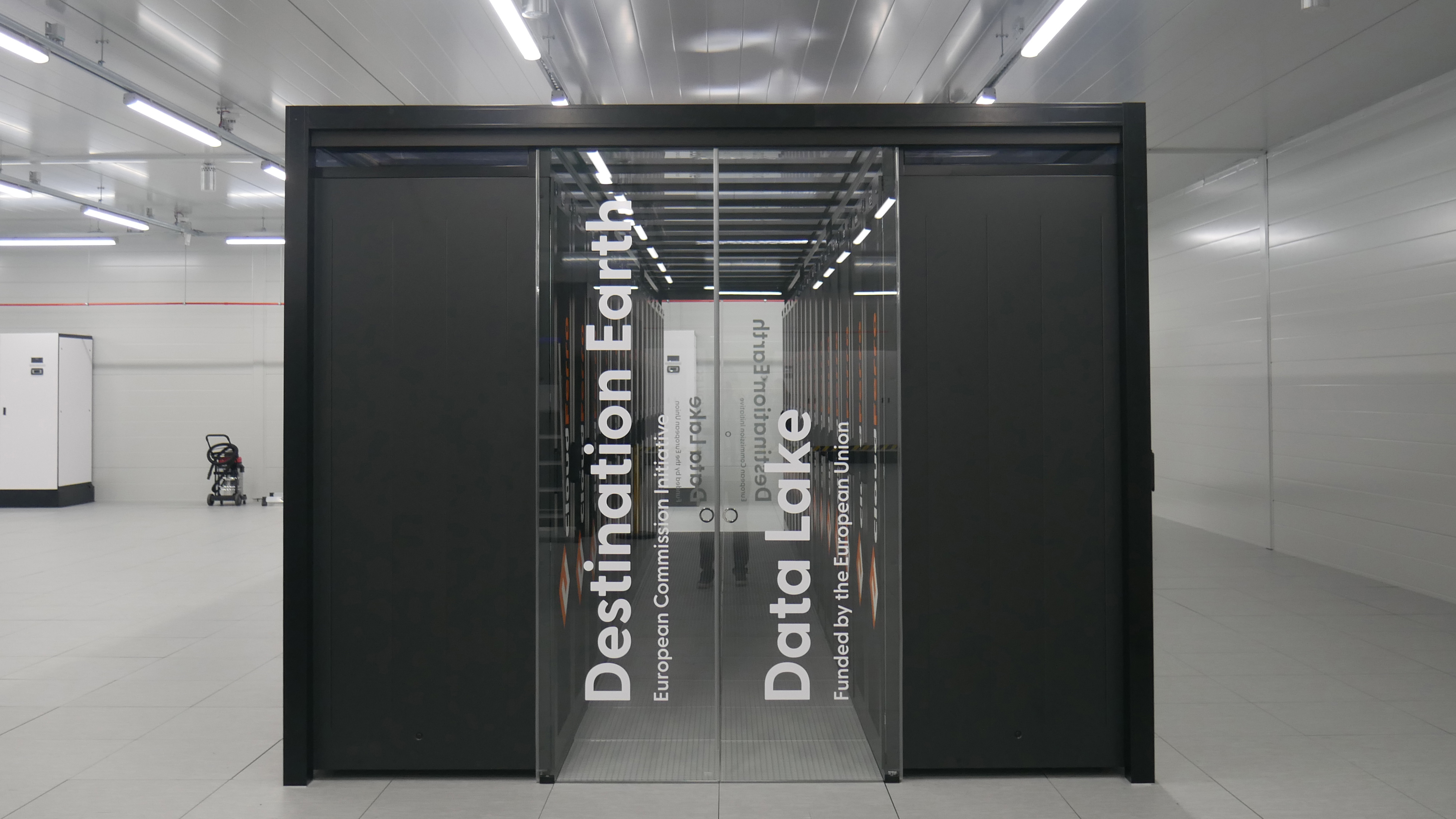 Destination Earth: The digital twin helping to predict – and prevent – climate change
Supported How the European Commission is hoping to fight back against climate change with a perfect digital twin of our planet, powered by Finland's monstrous LUMI supercomputer
-
Supercomputing in the real world
Supported From identifying diseases more accurately to simulating climate change and nuclear arsenals, supercomputers are pushing the boundaries of what we thought possible
-
 What is exascale computing? Exploring the next step in supercomputers
Supported 60 years after the birth of the first supercomputers, we are entering a new era
-
 Discover the six superpowers of Dell PowerEdge servers
whitepaper Transforming your data center into a generator for hero-sized innovations and ideas.
-
 Enhance end-to-end data security with Microsoft SQL Server, Dell™ PowerEdge™ Servers and Windows Server 2022
whitepaper How High Performance Computing (HPC) is making great ideas greater, bringing out their boundless potential, and driving innovation forward


