Microsoft hails advances in glass data storage technology that could preserve information for 10,000 years
Project Silica uses lasers to encode data into borosilicate glass, where it stays stable for thousands of years
Sign up today and you will receive a free copy of our Future Focus 2025 report - the leading guidance on AI, cybersecurity and other IT challenges as per 700+ senior executives
You are now subscribed
Your newsletter sign-up was successful
Microsoft reckons it's made a major breakthrough in glass data storage technology, touting a new technique it says can preserve information for 10,000 years.
Magnetic tape and hard drives degrade within decades, leading to research into glass - a permanent data storage material that is resistant to water, heat, and dust.
In the past, glass-based data storage has required expensive fused silica - a type of glass that is relatively difficult to manufacture and available from only a few sources.
However, the new Project Silica technology - detailed in an article in Nature - means it's possible to use the same borosilicate glass found in kitchen cookware and oven doors.
"This advance addresses key barriers to commercialization: cost and availability of storage media," said Microsoft partner research manager Richard Black.
"We have unlocked the science for parallel high-speed writing and developed a technique to permit accelerated aging tests on the written glass, suggesting that the data should remain intact for at least 10,000 years."
Microsoft’s new glass data storage technology
The new technique allows hundreds of layers of data to be stored in glass just 2mm thick, as with previous methods. However, the reader for the glass now needs only one camera, not three or four, thereby reducing cost and size.
Sign up today and you will receive a free copy of our Future Focus 2025 report - the leading guidance on AI, cybersecurity and other IT challenges as per 700+ senior executives
The writing devices also require fewer parts, making them easier to manufacture and calibrate and enabling them to encode data more quickly.
Femtosecond lasers, which fire high-power laser pulses quadrillionths of a second long, are focused on a point within the glass to modify its optical properties and encode data as voxels, the 3D equivalent of pixels.
Microsoft said it's now able to cut the number of pulses used to form the voxel from many to only two. Crucially, the polarization of the first pulse is not important to the polarization of the voxel formed.
Notably, the tech giant has been able to build on this to enable pseudo-single-pulse writing. This involves a single pulse that can be split after its polarization is set to simultaneously form the first pulse for one voxel - where the polarization doesn’t matter - and the second pulse of another, where the set polarization is essential.
New storage methods could be coming soon
As part of the project, Microsoft revealed it has invented a new type of data storage in glass called “phase voxels”, in which the phase change of the glass is modified instead of its polarization, showing that only a single pulse is necessary to make a phase voxel.
"We demonstrated that these phase voxels can also be formed in borosilicate glass and devised a technique to read the phase information from phase voxels encoded in this material,” Black said.
“We showed that the much higher levels of three-dimensional inter-symbol interference in phase voxels can be mitigated with a machine learning classification model."
Meanwhile, by using a mathematical model of pre-heating and post-heating within the glass with a new multi-beam delivery system, the team found that many data voxels can be written in proximity in the glass at the same time, significantly increasing writing speed.
The team has also developed a new way to optimize symbol encodings using machine learning, along with a better way to understand the trade-off between error rates, error protection, and error recovery when evaluating new digital storage systems.
Crucially, a new non-destructive optical method identifies the aging of data storage voxels within the glass, finding it can support data lasting 10,000 years.
The company demonstrated these techniques with several proofs of concept - including storing Warner Bros' Superman” movie on quartz glass, and partnering with Global Music Vault to preserve music under ice for 10,000 years.
"The research phase is now complete, and we are continuing to consider learnings from Project Silica as we explore the ongoing need for sustainable, long-term preservation of digital information," said Black.
FOLLOW US ON SOCIAL MEDIA
Make sure to follow ITPro on Google News to keep tabs on all our latest news, analysis, and reviews.
You can also follow ITPro on LinkedIn, X, Facebook, and BlueSky.
Emma Woollacott is a freelance journalist writing for publications including the BBC, Private Eye, Forbes, Raconteur and specialist technology titles.
-
Using AI to generate passwords is a terrible idea, experts warnNews Researchers have warned the use of AI-generated passwords puts users and businesses at risk
-
Poor workplace communication is confusing your colleagues and destroying productivityNews Engaging with colleagues via email or chat platforms wastes time and hampers team alignment
-
Wasabi has big plans for its EMEA partner program in 2026News The cloud storage vendor’s new-look channel initiative includes a new Systems Integrator program
-
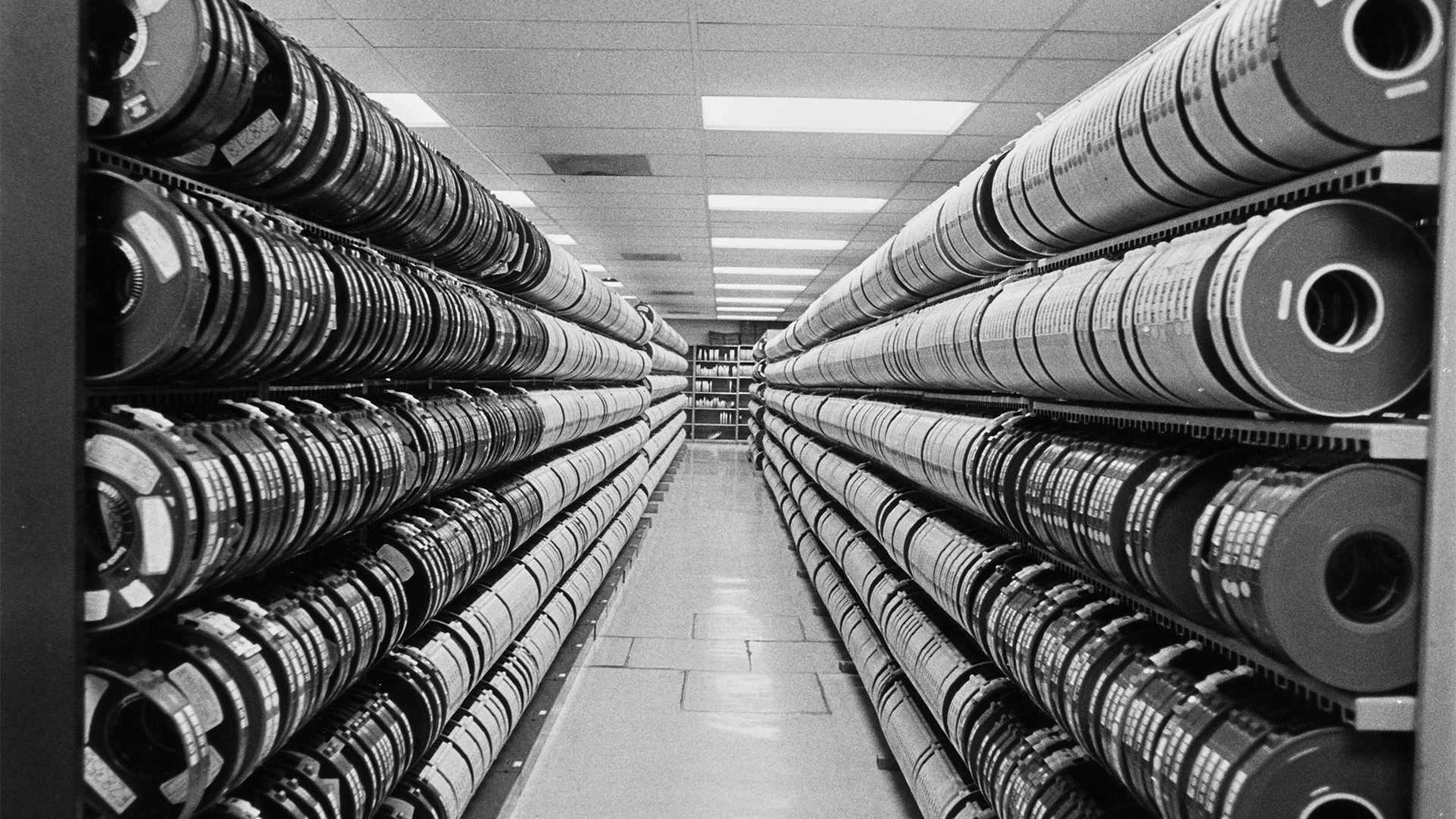
Magnetic tape is going strong in the age of AI, and it's about to get even better – new design materials and capacity boosts mean it's still an enterprise favoriteNews Magnetic tape storage might seem like a relic of a bygone era, but it’s still going strong in 2025 – and new upgrades mean it’s set to get even better.
-
Dropbox is adding a range of handy new AI features – here’s what users can expectNews Long-awaited features from Dash AI will be integrated within Dropbox
-
Seagate and Acronis are teaming up to drive MSP storage capabilitiesNews Acronis will incorporate Seagate’s Lyve Cloud Object Storage into its archival storage offerings to help MSPs meet AI-driven data demands
-

Forget about AI unless you’ve got the right hardwareNews Research from Microsoft shows enterprises ramping up AI adoption are neglecting hardware upgrades - and it's holding them back.
-
Microsoft targets enterprises with new Intel-powered Surface devices – but they come with a hefty price tagNews Microsoft has unveiled the launch of the new Surface Pro 11 and Surface 7 laptop devices with Intel chips.
-
Work and innovate everywherewhitepaper Protection across AI attack vectors
-
Microsoft refuses to back down on Windows 11 hardware requirementsNews The tech giant says it'll keep hardware specifications for Windows 11