AWS unveils ‘Amazon Q’ enterprise-grade AI assistant
The Amazon Q generative AI assistant will have applications across multiple business functions

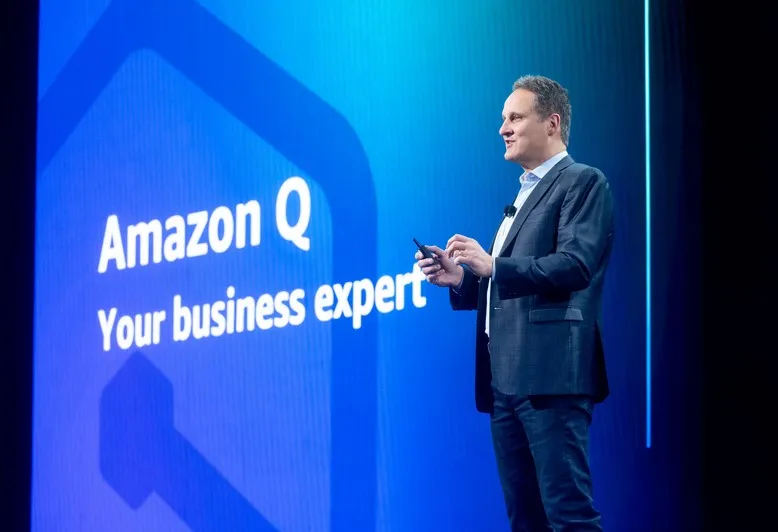
AWS has unveiled the launch of ‘Amazon Q’, a generative AI-powered chat assistant designed specifically for enterprises.
Chief executive Adam Selipsky announced the launch of the AI assistant during his open keynote at AWS re:Invent, the cloud giant’s annual flagship conference in Las Vegas.
Amazon Q will provide users with detailed business insights based on natural language prompts, and is capable of providing tailored content generation based on specific business needs.
This includes the ability to make changes to source code to streamline application development, Selipsky told delegates at the conference, as well as the ability to automatically generate document summaries.
“Amazon Q brings a set of capabilities to support developers and IT professionals,” the cloud giant said in an announcement online. “Now you can use Amazon Q to get started building applications on AWS, research best practices, resolve errors, and get assistance in coding new features for your applications.”
As part of the announcement, Selipsky fired a broadside at industry competitors Microsoft and OpenAI, noting that AI chat assistants have typically been viewed with concern by enterprises due to the risk of data leakage and privacy-related issues.
“These days it seems like just about everyone is experimenting with them [AI chatbots],” Selipsky said. “What the early providers in the space have done is genuinely exciting for consumers, but in a lot of ways these applications don’t actually work, at work.”
“While their general knowledge and their capabilities are great. They don’t know your company, they don’t know your data, they don’t know your operations and this limits how useful their suggestions can be.
RELATED RESOURCE

Configure the right infrastructure to accelerate the training and deployment of machine learning models
DOWNLOAD NOW
“They also don’t know much about who you are at work. They don’t know your role, your preferences, the information you use, or what you do and don’t have access to.”
Selipsky said that, critically, other providers such as OpenAI have launched tools “without data privacy and security capabilities that virtually every enterprise wants”.
His comments follow highly publicized ChatGPT-related data leaks earlier this year, which prompted a host of organizations - including Microsoft itself - to prohibit the use of the chatbot in business environments.
Amazon Q: What can users expect?
Amazon Q has been described by AWS as a dedicated “business expert” designed to support workers in roles spanning multiple business functions.
The tool will provide users with immediate, relevant information and advice to help “streamline tasks, accelerate decision-making and problem solving, and help spark creativity and innovation at work”, the company said in an announcement post.
The generative AI assistant draws on internal company data to provide detailed insights into specific business processes, such as IT operations, software development, or business intelligence.
Critically, the tool works by “understanding your systems, your data repositories, your operations,” Selipsky said.
Amazon Q is being framed by AWS as a cross-functional tool that can be augmented and tailored to individual needs, and a direct competitor to OpenAI’s ChatGPT platform.
The launch of the assistant marks another major foray into the AI-powered assistant space for AWS after the launch of Amazon CodeWhisperer, its own equivalent of GitHub’s copilot service.
Amazon Q has officially launched in preview for AWS customers, with pricing starting at $20 per month, per user. A separate tier specifically for developers will be available for $25 per user, per month.

-
 A spate of cyber attacks has rocked Japan
News With over 100 cyber attacks impacting major sectors this year, Japan’s ruling party is calling for an emergency taskforce to strengthen AI defenses
-
 Top takeaways: The AI tokenomics challenge
Feature Why invisible metering, compounding agentic workflows, and production scale turn enterprise AI into an open tab – and how leaders can govern for measurable value


-
 Microsoft wants to tackle the biggest issue for UK AI adoption: confidence
News UK and Ireland CEO Darren Hardman says it's our responsibility to get AI into every corner of the UK
-
 Qlik achieves AWS Data Competency for relational database expertise
The recognition highlights the company’s cross-environment data integration, governance, and preparation capabilities on AWS
-
 "Right now, your washing machine is subject to more safety rules than AI": Microsoft's Brad Smith wants more AI kill switches
News Brad Smith has called for more regulation, saying the UK is well-positioned to lead
-
 OpenAI won't release next Astra model over safety worries
News AI developer says new agent didn't stay within the scope of tasks
-
 OpenAI says some researchers are blowing through $7,000 in AI tokens every day – but it’s a price the company appears willing to pay
News OpenAI has revealed that researchers now spend around $600 each day on AI tokens amidst a surge in agentic coding. Some, meanwhile, are using upwards of $7,000 worth of tokens per day.
-
 Six things OpenAI learned about AI from the Hugging Face incident
News OpenAI's report into AI going rogue reveals efforts at cheating and communicating — but also some well-behaved bots
-
 OpenAI forges closer ties with IBM in enterprise push
News The duo will combine OpenAI models and products with IBM Consulting expertise
-
 Microsoft has joined the growing list of companies cracking down on ‘tokenmaxxing’
News The company is updating internal guidance to reduce rising costs


