Everything you need to know about Claude Cowork, including features, pricing, and how to access the new productivity tool
The new Claude Cowork tool can work autonomously on basic tasks like sorting folders


Anthropic wants users to hand Claude their files and let the AI bot figure out what to do with them – but it warns that the system might choose to delete your files.
The AI developer this week unveiled Claude Cowork, which applies abilities created for Claude Code to non-coding tasks in an "approachable" way, the company said in a blog post, once users have given access to files, the wider web, or third-party data.
Tasks could include generating reports, organizing files, or creating a spreadsheet based on documents.
Anthropic said Claude Cowork was inspired by the way developers used Claude Code, the company's AI code generation tool.
"When we released Claude Code, we expected developers to use it for coding," Anthropic said. "They did – and then quickly began using it for almost everything else."
The aim, according to Anthropic, is to make it easier to put AI to work without constantly giving more context or instructions, or having to convert outputs into documents yourself.
"It feels much less like a back-and-forth and much more like leaving messages for a coworker," the company said.
What can Claude Cowork do?
Claude Cowork isn't just inspired by Claude Code, but built on the same "foundations", the company said – and that means the system will feel familiar to anyone who has already used the coding tool.
Notably, Cowork differs from the standard chatbot as it works by giving it access to a specific folder on your computer, in order to read and edit files – as well as create its own, as Anthropic has built-in skills for making presentations and other documents.
"It can, for example, re-organize your downloads by sorting and renaming each file, create a new spreadsheet with a list of expenses from a pile of screenshots, or produce a first draft of a report from your scattered notes," the company said.
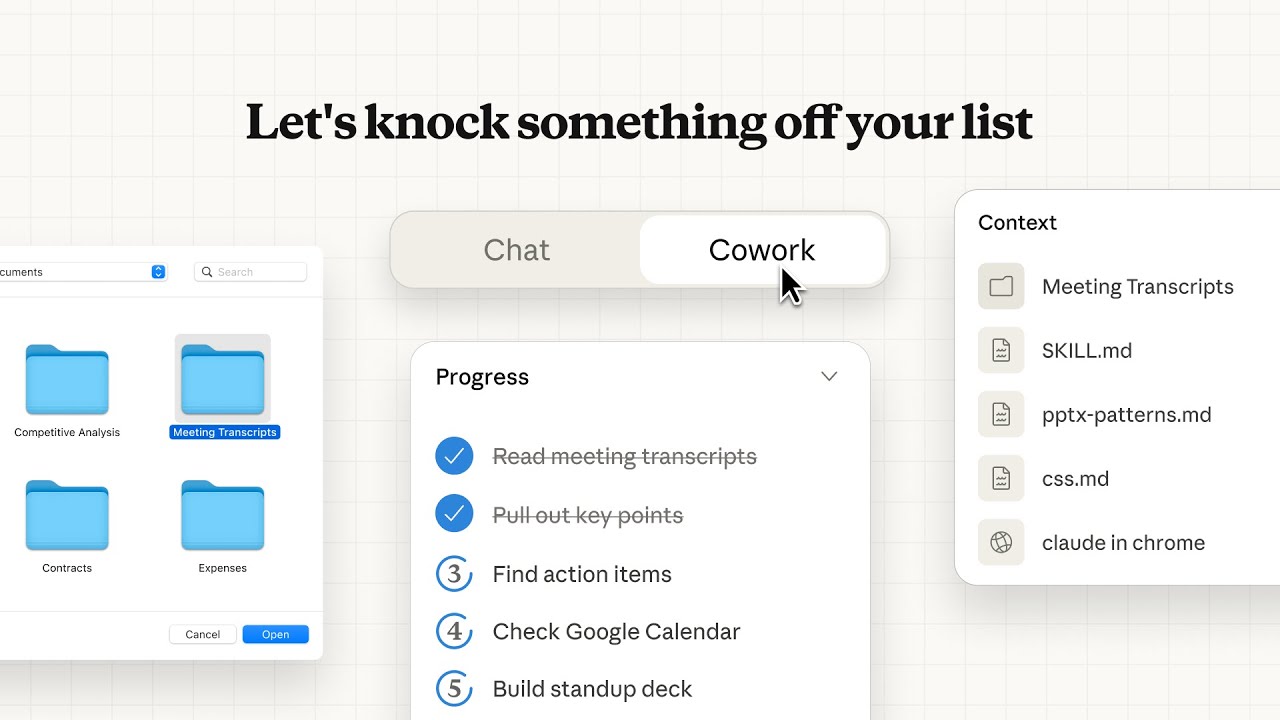
Anthropic said its Claude AI will then work with "more agency" than a chatbot, and multiple tasks can be queued up at once for the system to do at the same time.
"Once you’ve set it a task, Claude will make a plan and steadily complete it, while looping you in on what it’s up to," the company said.
Beyond desktop files, Cowork can access external files by using existing connectors, and can be paired with Chrome for web access.
How to access Claude Cowork
Claude Cowork remains in research preview and is available to Claude Max subscribers.
However, the company noted that access will be limited to those on the macOS app to begin with. Anthropic said it plans to offer access to Windows users too, but exact details on a release timeline are yet to be determined.
The aim here for Anthropic is to get a sense of how people use Cowork to drive further improvements and development before a full release.
Anthropic's warning
Claude Cowork will only access files that it's been given direct access to view, and will ask for approval at key stages of a task.
Anthropic did warn that users should perhaps limit the tool's use to a single folder, and urged users to keep separate backups of the files it's been set to work on. The reasoning here is that the bot could take "potentially destructive actions" such as deleting materials.
The company said Claude would only delete a file if instructed, but added: "Since there’s always some chance that Claude might misinterpret your instructions, you should give Claude very clear guidance around things like this."
Anthropic also warned about the risk of prompt injections, an attack vector in which hackers find a way to disrupt an AI bot's legitimate task with malicious instructions.
That's a threat faced by any AI agent, the company noted, and it's a concern raised by OpenAI too.
FOLLOW US ON SOCIAL MEDIA
Make sure to follow ITPro on Google News to keep tabs on all our latest news, analysis, and reviews.
You can also follow ITPro on LinkedIn, X, Facebook, and BlueSky.

-
 Microsoft's Brad Smith wants more AI kill switches
News Brad Smith has called for more regulation, saying the UK is well-positioned to lead
-
 Two groups account for a third of UK ransomware attacks
News Data from Cohesity has revealed that Europe has become a primary target as the number of US ransomware attacks declines


-
 Anthropic moves fast on AI safety concerns with Accenture “embedded evaluator” partnership
News The deal will see AI specialists embedded at Anthropic to monitor development practices
-
 Anthropic reportedly withholds access to Mythos 5.1 from UK safety testing body
News The decision marks the first time the AI Security Institute has been left out of pre-release evaluations of Anthropic models
-
 Anthropic says Claude Fable 5.1 ‘sets a new standard for coding, knowledge work, and long-running problem-solving tasks’
News The launch of Claude Fable 5.1 includes new security and privacy safeguards, and at a cheaper rate
-
 AI testing firm Irregular the source of ‘misconfigurations’ that led to Meta, OpenAI, and Anthropic AI incidents
News The “frontier security lab” has been referenced in multiple cyber incident statements
-
 Why the US imposed export controls on Anthropic’s Fable and Mythos models – and why they’ve been lifted
News Anthropic tightens up safeguards and offers expanded early access to US government to end export control issues
-
 Anthropic touts new Claude Sonnet 5 model range, offering performance ‘close to that of Opus 4.8, but at lower prices’ – here’s what users can expect
News Claude Sonnet 5 comes with intuitive agentic capabilities, performance boosts, and cost-efficient ‘effort levels’
-
 Copilot Cowork is now generally available: Everything you need to know, including pricing, usage limits, and new features
News A host of partner plugins are already available for Copilot Cowork, and more are coming
-
 Anthropic suspends Fable and Mythos systems "for all users" after US government claims jailbreak risk
News Despite complying with the government, Anthropic suggests it's only a "potential narrow, non-universal jailbreak"


