Dreamforce 2026 ended with a resounding bang in San Francisco, with the Dreamfest concert welcoming Usher and Gwen Stefani to Oracle Park for a blockbuster show.
Indeed, the event topped off a week in which Salesforce spared no expense touting a sweet escape from the traditional user interface customers have relied on for years.
The big talking point from the annual conference centered around the launch of AIforce, which the company describes as a new "live interface layer" designed specifically for the agentic AI era.
If you're wondering exactly what that means, you're not alone. Admittedly, I left the opening keynote with more questions than answers. Yet over the course of the week and deeper dives in subsequent keynote sessions, the aim becomes quite clear.
Historically, users have accessed the Salesforce platform through a traditional interface such as a web browser or application. That not only limited who could use Salesforce, but also how much information they could access at any one time.
Thousands of enterprises host their most valuable data across their ecosystem. From CRM records and unstructured data to a myriad of documents and assorted metadata, it's a veritable gold mine.
But accessing those various data sources and workflows meant traversing an array of different dashboards and interfaces. That can be a laborious task, and it creates blind spots for users and prevents them from unlocking value from this data.
Salesforce repeatedly used the term "trapped value" across the event, highlighting the impact this has on enterprises, particularly amidst a period of rapid agentic AI adoption.
Opening up for agents
Salesforce seems determined to ensure that agents are front and center moving forward. Building on two years of development on this front, beginning with Agentforce.
With AIforce, the aim here is to simplify access for agents, allowing them to plug into the data, workflows, and business logic hosted on the platform. That not only gives agents a direct line to business data, but also removes the need for users to even log into the platform. Agents from Claude or OpenAI can be used to access data, while Slack also gives users a mainline.
This clearly builds on the company's Headless 360 service, which "exposes" databases to agents through APIs, command-line interfaces (CLIs), and model context protocol (MCP) tools.
Unveiled in April, this marked the first big push toward a Salesforce without a traditional UI. With AIforce, the company wants enterprises to finally "break free".
At the time, co-founder Parker Harris pondered, "Why should you ever log into Salesforce again? Maybe you never will."
On this, he was clearly correct. Exactly how many enterprises are comfortable giving agents a direct line to mission-critical data is up for debate, though. "Trust" ranked among the most used terms throughout the keynote and subsequent sessions, and it's obvious the company is keen to calm lingering concerns on this front.
Historically, Salesforce has put its money where its mouth is in this regard, but I suspect this latest push isn't entirely about improving ease of use for customers.
Salesforce is insulating itself
The move here comes at a critical time for Salesforce and the software industry at large. While Marc Benioff shrugged off claims of a looming 'SaaSpocalypse' during his opening keynote, there's no denying that AI is having a marked impact on the SaaS space.
Research from Gartner earlier this year noted that agentic AI will break the traditional SaaS model, urging providers to ditch "legacy dashboards".
The firm projected that up to $234 billion of application spending will be exposed to "agentic arbitrage" by 2030. This is a process whereby agents render services obsolete by removing the need to work through traditional user interfaces. Sound familiar?
While Benioff thinks the SaaSpocalypse is "nonsense", it appears that Salesforce is insulating itself from future market shocks such as those witnessed earlier in 2026.
When Anthropic unveiled Claude Cowork in January, it sent software stocks into meltdown amidst concerns it was muscling in on software providers. The CRM giant was caught up in this, with share prices plunging 40% in the first half of 2026.
I suspect this was a wake-up call for Salesforce and prompted a rethink on how it can remain relevant in an era where highly aggressive AI developers are keen to tap into any possible revenue streams.
As I noted ahead of the conference, Salesforce appears to have an "if you can't beat them, join them" mindset right now. The Claudeforce launch earlier this month and now the arrival of AIforce are a testament to that.


 Dreamforce 2026 and the dangers of AI
 Firms pledge increased financial support for public package registries

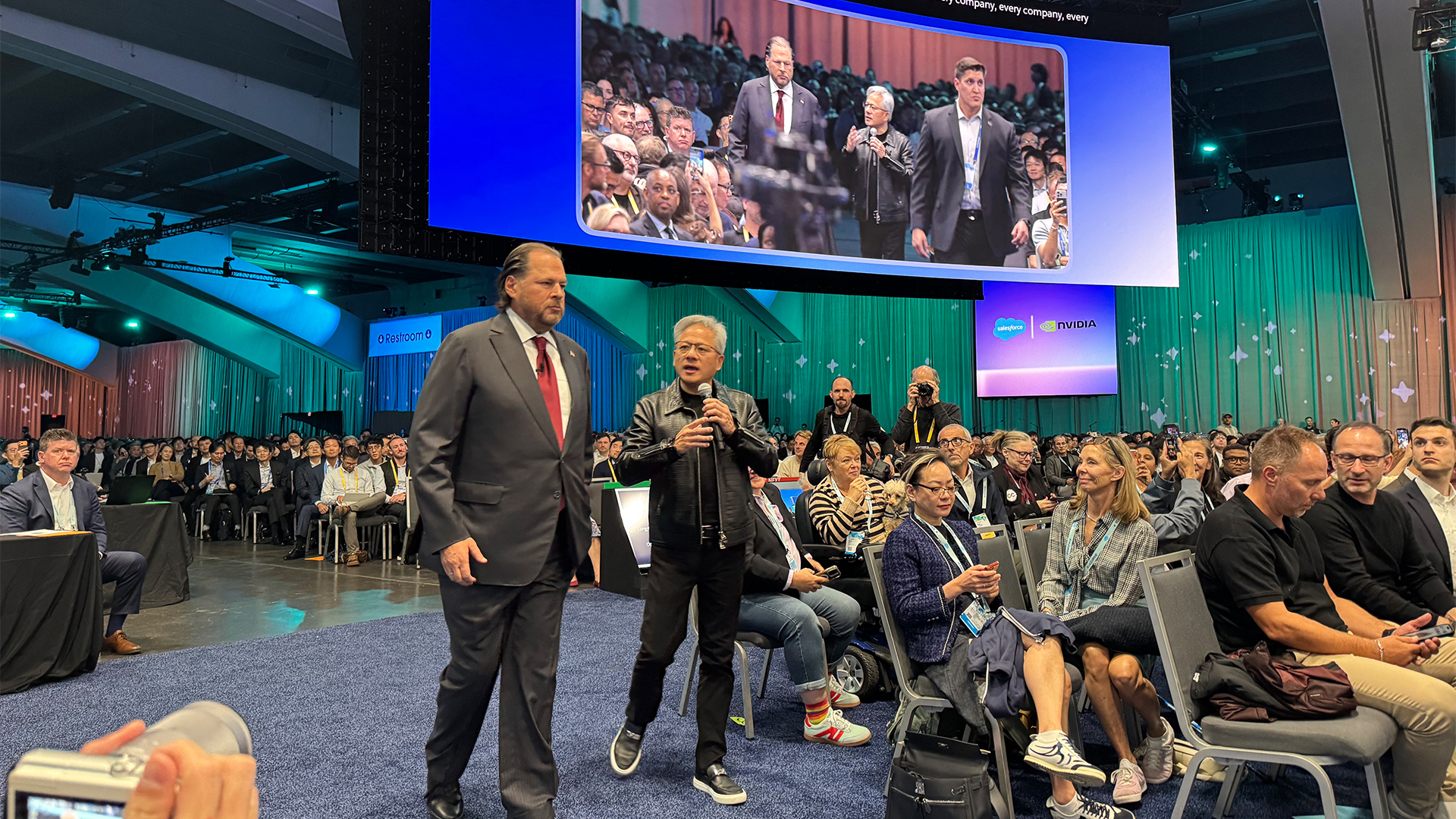 ‘It’s going to make software so much better’: Marc Benioff and Jensen Huang aren’t sold on the ‘SaaSpocalypse’ – AI will take the industry to the next level
 Marc Benioff thinks AI isn't quite ready to replace software engineers
 Dreamforce 2025: What's an agentic OS?
 Slack is now the key to Salesforce’s agentic AI plans
 Salesforce says ‘Microsoft’s anticompetitive tying of Teams' harmed business in triumphant response to EU concessions agreement
 ‘Maybe we aren't going to hire anybody this year’: Marc Benioff says Salesforce might not hire any software engineers in 2025 as the firm reaps the benefits of AI agents
 Slack AI agents shift looks to “unify” enterprise data and drive team synergy
 A DevOps guide to the Salesforce platform


